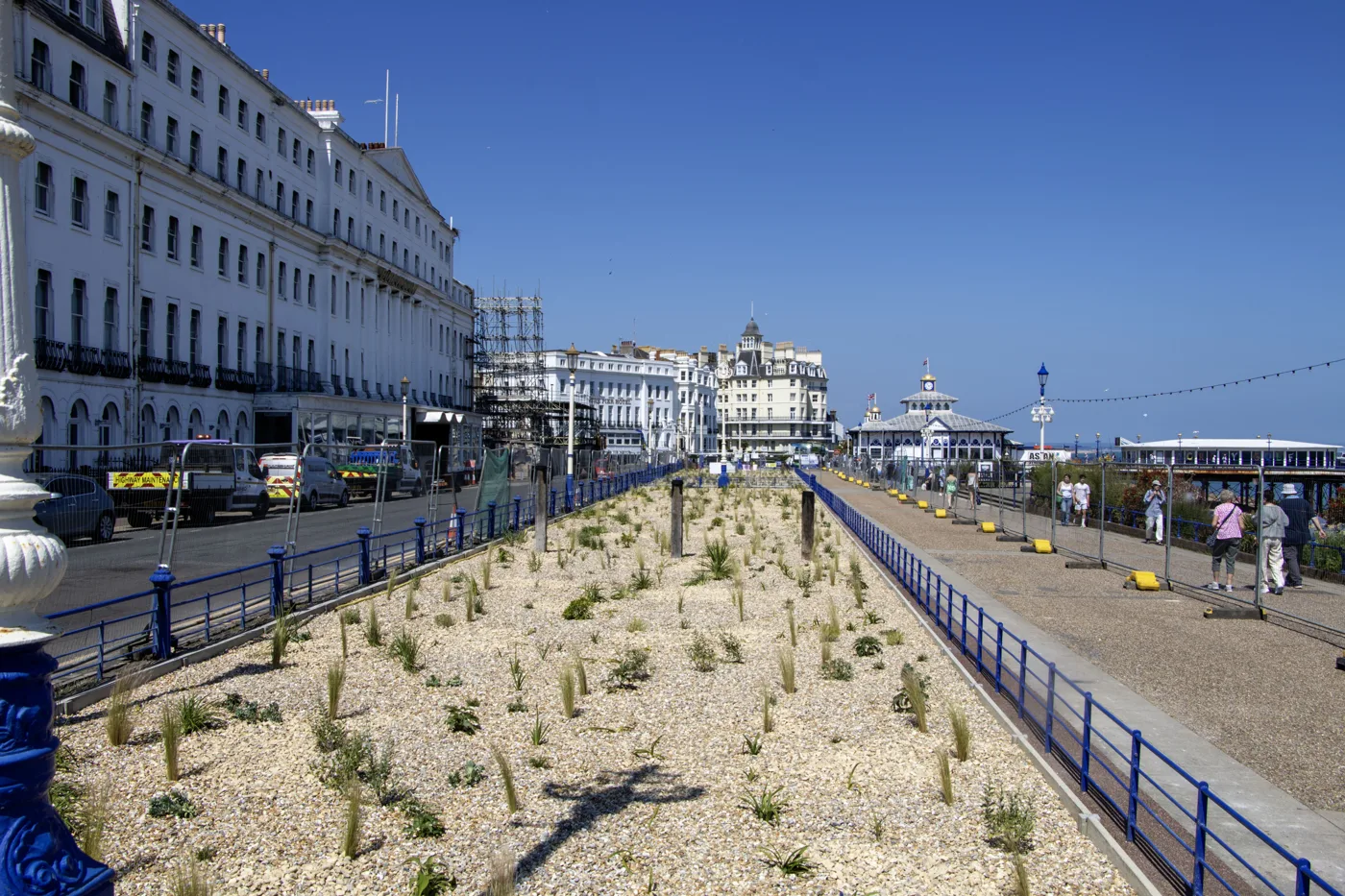

16,014 people answered and 69.56% backed the sustainable planting over Victorian bedding. The council says the new scheme now stays, and the report shows why.
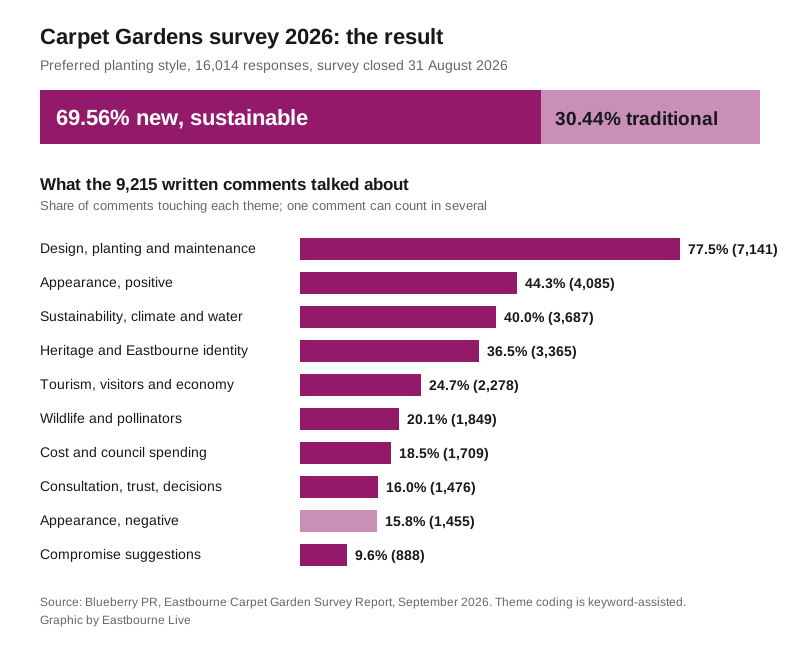
The new, sustainable planting at Eastbourne’s Carpet Gardens is staying. An independent survey drew 16,014 responses, and 69.56 per cent preferred the new style. The other 30.44 per cent wanted the traditional Victorian bedding back.
Eastbourne Borough Council published the result on Friday 11 September. It said it “will now move forward with the sustainable scheme, continuing to refine and enhance the planting”. (Council news release)
If every respondent answered the preference question, that works out at roughly 11,100 people for the new planting and 4,900 for the old. The report gives percentages only, so those two counts are our arithmetic.
A much bigger and clearer answer than last year
This was the council’s second survey on the gardens. The 2025 one drew 3,759 responses. This year’s drew more than four times as many.
The two surveys asked different questions, so the numbers do not line up exactly:
- 2025: 51 per cent were positive about the new style and 41 per cent negative
- 2026: 69.56 per cent chose the new style when asked to pick one
Last year’s figures come from the council’s Carpet Gardens page. When we reported the survey opening in August, that 51 to 41 split made the vote look genuinely open. It was not close in the end.
Who ran it and who could answer
The survey was run by Blueberry PR, a Hailsham firm, not by the council. The council says community campaigners chose the firm from a list of providers because of its independence from the town hall.
Residents, visitors and businesses could all respond, online or on paper. The report does not split the result by where people live. So there is no way to tell from it whether Eastbourne residents voted differently from visitors.
What the 9,215 comments said
More than half of respondents, 9,215 people, also left a written comment. The full report sorts them into ten themes. The biggest are:
| Theme | Comments | Share |
|---|---|---|
| Design, planting and maintenance | 7,141 | 77.5% |
| Appearance, positive | 4,085 | 44.3% |
| Sustainability, climate and water | 3,687 | 40.0% |
| Heritage and Eastbourne identity | 3,365 | 36.5% |
| Tourism, visitors and town economy | 2,278 | 24.7% |
| Wildlife, biodiversity and pollinators | 1,849 | 20.1% |
| Cost, value and council spending | 1,709 | 18.5% |
| Consultation, trust and decision-making | 1,476 | 16.0% |
| Appearance, negative | 1,455 | 15.8% |
| Compromise and improvement suggestions | 888 | 9.6% |
One comment can count in several themes, so the shares add up to more than 100. The report also warns that its coding is “keyword-assisted”. It says the positive and negative appearance counts are “theme indicators, not a direct measure of overall sentiment”.
The report’s most useful finding is that the answer is not a clean split into two camps. In its words, “a noticeable strand supports the sustainable principle but criticises the current visual execution”. The complaints it lists are specific:
- too many grasses
- a lack of colour
- an untidy or neglected look
- a sense that the beds do not resemble the high-impact gardens people remember
Among the example comments it prints, one respondent who liked the idea of sustainability asked for half the grasses to come out and taller plants such as red hot poker to go in. Another suggested the end planters stay traditional “as a nod to heritage”.
Process came up too. 1,476 comments raised whether residents had been consulted properly, or whether the council was listening.
The money behind it
The council’s own figures show why it wanted the change. Over ten years, it puts planting and maintenance at:
- £1,060,000 for traditional bedding, replanted twice a year
- £257,000 for the sustainable scheme, including £137,000 spent planting it in May 2025
That is a difference of £803,000 over a decade, on the council’s arithmetic. Yearly upkeep of the new planting is put at £12,000, against £106,000 for bedding. (Council cost table)
What has not been decided
The council has not said:
- whether the one section still planted in traditional bedding will be kept or replanted
- what “refine and enhance” will mean in practice, such as more colour or fewer grasses
- whether the annual maintenance budget changes
Councillor Jim Murray, Cabinet Member for Carbon Neutral 2030, said: “We will continue developing a display that is beautiful, resilient, and better for the environment. I’m excited to see how the gardens flourish next year and beyond.”
What it means for you
- The gardens on Grand Parade, opposite the pier, stay perennial. They should change through the year rather than being dug up and replanted each spring and autumn.
- If you have a view on how the planting looks, the survey is closed, but the report shows colour and grasses are the live argument. The council says updates will come on its website and social channels. Its news alerts sign-up is here.
- You can read every theme and the example comments in the 17-page report.
- Heading down to see it? Our parking in Eastbourne page has the seafront car parks and tariffs.
Sources
- Carpet Gardens survey result: majority support new sustainable planting, Eastbourne Borough Council news release, 11 September 2026.
- Eastbourne Carpet Garden Survey Report, Blueberry PR, September 2026: response total, result, comment themes and example responses.
- Eastbourne Carpet Gardens Survey 2026, Eastbourne Borough Council: cost table, 2025 survey results and who could respond. Read 16 September 2026.
Have your say