
300 Eastbourne households were in temporary accommodation on 31 March, with 283 children, as the council leader took the housing case to MPs.
Eastbourne Borough Council was housing 300 homeless households in temporary accommodation at the end of March, including 283 children. The figures come from the government’s latest statutory homelessness tables for January to March 2026.
The council’s leader, Councillor Stephen Holt, was due to give evidence to MPs on Tuesday 27 October. The session was part of an inquiry by the All-Party Parliamentary Group for Council and Social Housing into what stops councils building and buying social homes. The council announced the invitation on Monday. It said the invitation came from the housing charity Shelter.
Councillor Holt was to draw on a joint written submission from three councils: Eastbourne, Lewes and Hastings.
What the three councils told the inquiry
The council’s announcement says the submission sets out:
- rising temporary accommodation costs and pressure on housing budgets
- rising construction, borrowing and maintenance costs
- pressure on Housing Revenue Accounts, the ring-fenced budgets for council homes
- constrained land supply and no access to affordable development finance
- a call for reform of how temporary accommodation is funded
“The housing emergency in Eastbourne is not unique,” Councillor Holt said in the announcement. “Councils across the country continue to spend vast amounts of money on temporary accommodation because there simply are not enough genuinely affordable homes available for local people.”
Councillor Glenn Haffenden, leader of Hastings Borough Council, said residents could not move into privately rented homes, “which means we can’t move people off housing waiting lists so these continue to grow.”
The inquiry will make recommendations to ministers. The council said Councillor Holt’s earlier national campaign on temporary accommodation included a housing summit attended by 158 councils.
Eastbourne’s numbers
Temporary accommodation is where a council places a homeless household while it looks for a settled home. These are the government’s figures for Eastbourne at the end of each quarter, from table TA1 of the detailed local authority tables.
| Date | Households | With children | Children | In B&Bs |
|---|---|---|---|---|
| 31 March 2025 | 308 | 160 | 339 | 72 |
| 30 September 2025 | 322 | 174 | 340 | 70 |
| 31 December 2025 | 308 | 160 | 313 | 72 |
| 31 March 2026 | 300 | 148 | 283 | 85 |
The total has eased a little over the year, from 308 to 300. The number of children fell further, from 339 to 283. But more households were in bed and breakfast hotels in March than a year earlier: 85, up from 72. None of the 85 had children with them.
Where the 300 households were living on 31 March:
- 137 in nightly paid, privately managed accommodation, 90 of them with children
- 85 in bed and breakfast hotels, including shared annexes
- 77 in council or housing association homes, 58 of them with children
- 1 in a hostel
How Eastbourne compares
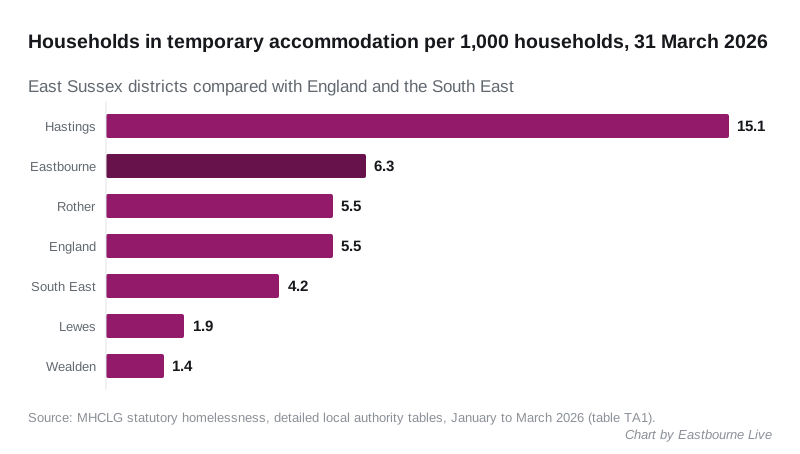
Eastbourne had 6.3 households in temporary accommodation for every 1,000 households in the borough. That is above the England average of 5.5 and the South East’s 4.2. London pulls the England figure up: outside London the rate was 2.8.
Hastings, along the coast to the east, had the highest rate in East Sussex at 15.1, with 623 households. Lewes district had 85 households, a rate of 1.9.
What it means for you
If you are homeless or about to lose your home, the council has a legal duty to help. Under the Homelessness Reduction Act 2017, its duty to try to prevent it starts when you are likely to become homeless within 56 days, so contact its housing team as early as you can.
The figures also explain why the council keeps returning to housing. Every household in a bed and breakfast or nightly paid room is a cost the council meets until a settled home is found. That is the pressure the three councils put to MPs.
The APPG has not yet published its findings. We will report its recommendations when they appear. For the borough’s planned new homes, see our report on the Local Plan consultation, open until 13 November.
Sources
- Eastbourne Borough Council: Council leader to take joint housing campaign to Parliament, 26 October 2026.
- MHCLG live tables on homelessness: detailed local authority tables for January to March 2025, July to September 2025, October to December 2025 and January to March 2026, table TA1.
Have your say