
Ratton, Parkland Infant, The Haven and Shinewater met or beat the expected standard in every area, with safeguarding met at all four. What the new grades mean.
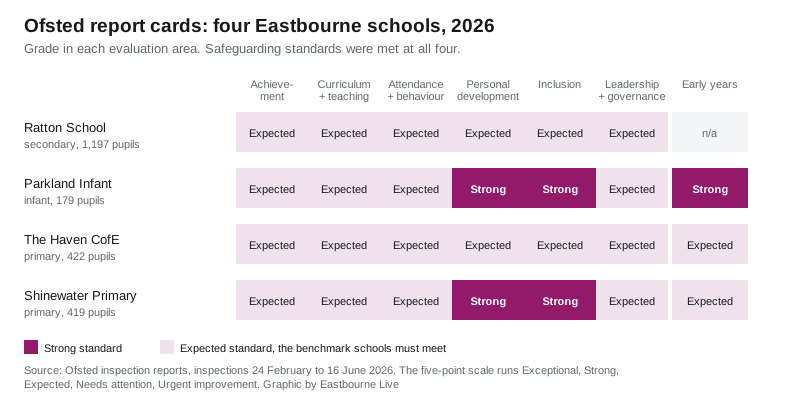
Four Eastbourne schools have been inspected under Ofsted’s new report cards since February, and none was graded below the expected standard in any area. Two of them, Parkland Infant School and Shinewater Primary School, were graded at the higher “strong standard” in three areas each. Safeguarding standards were met at all four.
That is worth setting out clearly, because the new grading scale is unfamiliar and it is easy to read “expected standard” as a near miss. It is not. Ofsted’s own definition, printed in every report, is that the school “is fulfilling the expected standard of education and/or care”. It is the benchmark schools are required to meet.
How the new grades work
Ofsted stopped giving schools a single overall word, Outstanding to Inadequate, in September 2024. Since the renewed inspection framework took effect on 10 November 2025, inspections produce a report card instead: each area is graded separately on a five-point scale of Exceptional, Strong standard, Expected standard, Needs attention and Urgent improvement. Safeguarding sits outside that scale and is judged only “met” or “not met”.
The areas are achievement, curriculum and teaching, attendance and behaviour, personal development and wellbeing, inclusion, and leadership and governance, plus early years for primaries and post-16 provision for schools with a sixth form. There is no longer any headline grade to average them into, which is a change worth knowing about before you compare two schools on a single word.
What each report says
Ratton School, Park Avenue, inspected 19 May 2026, report published 8 July. The borough’s largest secondary, with 1,197 pupils against a national average of 1,067 for its phase, was graded at the expected standard in all six areas. Inspectors found pupils “typically make positive progress through the curriculum” and that key stage 4 examination results are close to national averages, including for disadvantaged pupils, who make up 26.65 per cent of the roll. Headteacher: Gavin Peevers.
Parkland Infant School, Brassey Avenue, inspected 12 May 2026, published 18 June. The strongest set of grades of the four. Early years, inclusion and personal development and wellbeing were all graded strong standard. Inspectors described children engaging “extremely well in a rich and ambitious range of activities across all areas of learning”, and support for pupils with special educational needs and disabilities as “highly effective”. The school has 179 pupils and is part of The Parkland Federation. Headteacher: Sally Simpson.
The Haven Church of England Methodist Primary School, Atlantic Drive at Sovereign Harbour South, inspected 24 February 2026, published 7 May. Expected standard in all seven areas, including early years. Inspectors found outcomes in reading, writing and mathematics close to national averages by the end of key stage 2, with writing “impressive”. It has 422 pupils, above average for a primary. Headteacher: Rosalie Collett.
Shinewater Primary School, Milfoil Drive in Langney, inspected 16 June 2026, published 21 July. Strong standard for inclusion and for personal development and wellbeing, expected standard in the other five areas. Inspectors recorded that “leaders have high ambitions for all pupils” and that children in the Nursery “get off to a flying start”. The context matters here: 45.69 per cent of its 419 pupils are eligible for free school meals, well above the 26.3 per cent national average, the highest deprivation measure of the four schools. Headteacher: Helen Evason. The school is part of The Swale Academies Trust.
The Eastbourne Academy: still in intervention, but moving
The borough’s other recent Ofsted document is not a report card. A monitoring inspection of The Eastbourne Academy in Hampden Park took place on 29 April 2026 and was published on 16 June. It was the second monitoring visit since the school was judged to require significant improvement at a graded inspection in January 2025, when quality of education, behaviour and attitudes, and leadership and management were all rated Inadequate.
The monitoring letter does not award grades. It reports progress, and on that the finding is positive: “leaders and trustees are taking effective action to improve the school but continued work is needed to remove the requires significant improvement designation”. Inspector Linda Culling recorded that behaviour “has improved considerably”, that in-school truancy “has been eradicated”, and that pupils told inspectors the changes were “noticeable” and “very welcome”. A rise in suspensions since Christmas is attributed to the tightening of expectations rather than to worse behaviour.
Attendance remains the unresolved problem. The letter says overall attendance is still below national averages despite some marginal improvement over two academic years, that severe absence “is not improving rapidly enough”, and that the school has recently strengthened the leadership of attendance. The school had 772 pupils on roll at the time of the visit, against a capacity of 900. A new consultant headteacher has joined since the last inspection.
What it means for you
If you are choosing a school, read the areas, not a headline. There is no overall grade to compare any more, and a school at the expected standard across the board has met the bar. The differences that will matter to your child are more likely to be in the specific areas: Parkland Infant’s early years grade, or Shinewater’s inclusion grade, tell you more than any single label used to.
Check the inspection date, not the publication date. They can be months apart. The Haven was inspected in February and its report appeared in May. What you are reading is a picture of the school on the inspection date, and the reports say so.
Reports are free to read in full. Every one is on Ofsted’s report finder, searchable by school name or postcode, with the PDF attached to each school’s page. Schools with any area graded “needs attention” or “urgent improvement” get monitoring inspections, so a school in that position will be revisited rather than left for four years.
If you want to complain about a school, the route depends on the type of school and starts with the school’s own complaints procedure. Gov.uk sets out which body handles what, including academies, private schools and special educational needs provision.
Local information
- Eastbourne A-level results 2026: what the town’s colleges published, and the deadline to challenge a grade
- Eastbourne house prices and things to do in Eastbourne
- Eastbourne roadworks and travel for the school run
Have your say