
Southern's weekday off-peak cuts between Eastbourne and London will now run until at least mid-October. What the MP was told, and how to claim money back.
The reduced weekday timetable between Eastbourne and London is now expected to last longer than the four weeks passengers were promised. The rail industry’s own incident notice for the route, updated on Wednesday 23 September at 16:14, is headed “Temporary changes to weekday off-peak services between Ore / Eastbourne and London Victoria until at least Mid-October”.
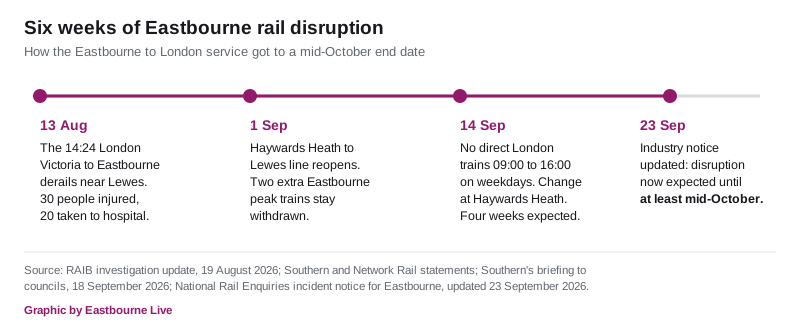
That is a firmer and later end point than the one Southern gave when the cuts began. The operator’s briefing to councils said the changes were “expected to remain in place for approximately four weeks” from Monday 14 September, which would have ended them in the week of 12 October.
Eastbourne’s MP, Josh Babarinde, met senior executives from Network Rail and Greater Thameslink Railway in the week to 23 September to press for faster progress. He set out what he asked for, and what he was told, in his own column published that day.
What is actually running
The changes apply Monday to Friday only. Weekend services run to the normal timetable. Southern’s briefing, republished in full by Ringmer Parish Council on 18 September after it was circulated by Lewes District Council, sets out the pattern:
- The usual half-hourly direct service between Ore, Eastbourne and London Victoria runs in the morning peak, until around 09:00.
- Between 09:00 and 16:00 there is no direct London train. A shuttle runs between Eastbourne and Haywards Heath, where you change.
- An amended service of the same frequency runs between Eastbourne and Ore.
- After 16:00 the half-hourly London Victoria service resumes. The first through train from London leaves at 16:24.
Two Eastbourne peak trains are missing on top of that, and they have been for longer. GTR’s press release of 28 August confirmed that the 06:47 Eastbourne to London Bridge and the 17:03 London Bridge to Eastbourne would continue not to operate from 1 September. Those are additional peak services that, in GTR’s words, “haven’t been” running “since 22 July as part of summer timetable changes”. The release describes seven such services across the south coast and Uckfield routes, then lists six.
If you are heading for Hastings or St Leonards Warrior Square from London, the industry notice says to use Southeastern services from London Bridge instead, at no extra cost. Your Southern ticket is also valid on other Southern services between London Victoria and Haywards Heath.
What the MP asked for
Babarinde wrote that he secured the meeting after writing to GTR, Network Rail and the Department for Transport about “the impact on passengers and Eastbourne’s local economy”. His account of the meeting covers four things:
- Rail executives told him extreme heat and prolonged dry weather had contributed to the problems, “with clay soils beneath parts of the railway drying out, cracking and warping”.
- Network Rail is “reinforcing sections of track, removing excess vegetation and carrying out essential safety and repair works”.
- He “pressed rail bosses to do everything possible to minimise disruption and restore reliable services as quickly as possible”.
- He asked whether support could be provided to affected communities, and GTR and Network Rail agreed “to explore options through their Community Improvement Fund”.
He also said the authorities “need to look beyond the immediate repairs and invest in a more resilient rail network to reduce the risk of this happening again”.
The fund is not compensation
The fund named in that last point is worth reading about before anyone expects money back from it. It is GTR’s Your Station, Your Community Improvement Fund, and its own page sets out what it is and is not.
- It is a charitable grants scheme, not a passenger payout. The page says the grants “are not an offer of employment or a payment for services, but are charitable grants”.
- Applicants are organisations, not individuals: registered charities, community interest companies, community groups, schools and colleges, business improvement districts, and town and parish councils.
- Its themes are mental health, employability, diversity and inclusion, environmental sustainability and improving station environments.
- The page for the fourth round currently states “Applications have now closed”.
- Money must be spent in full and projects completed within the 2026/27 financial year, April 2026 to March 2027.
- Bids of £10,001 to £50,000 have to be discussed with the community team first, and the page says bids over £10,000 that have not been discussed in advance will not be accepted.
So a successful bid could pay for something at Eastbourne or Polegate station. It would not refund a single delayed commute.
How to claim money back
The route for that is Delay Repay, and the terms are set out in Southern’s Passenger’s Charter. It pays out on delays of 15 minutes or more, whatever the cause, and it is measured on the time you should have arrived at your destination station rather than the delay to any one train.
For single and return tickets the charter commits to:
| Delay | Compensation |
|---|---|
| 15 to 29 minutes | at least 25% of the single fare, or of the affected portion of a return |
| 30 to 59 minutes | at least 50% |
| 60 to 119 minutes | at least 100% |
| 120 minutes or more | 100% of the single or the full return |
Season tickets are paid on the value of one journey, at the same 25, 50 or 100 per cent. The charter sets that value at 1/464 of the price for an annual, 1/120 for a quarterly, 1/40 for a monthly, 1/16 for a Flexi Season and 1/10 for a weekly.
That makes the arithmetic unflattering for Eastbourne commuters. The London Terminals annual season is £7,372, the price we checked on 9 August. One journey on it is worth £15.89, so a delay of 15 to 29 minutes returns about £3.97, and half an hour returns about £7.94. Compensation for season tickets is also capped at the cost of a pro rata full day’s travel.
There is a catch that matters while a reduced timetable is running. National Rail Enquiries says a delay is calculated “against either the normal timetable, or an amended timetable that is published in advance”. The slower shuttle-and-change journey is the published timetable now, so a journey that runs to that timetable is not a delay, however much longer it takes than the direct train you used to catch. If you decide not to travel at all, the same page says an unused ticket can be refunded without a fee by the retailer you bought it from.
Why the line is restricted
The speed restrictions trace back to the derailment near Lewes on Thursday 13 August, and the train involved was an Eastbourne one. The Rail Accident Investigation Branch’s investigation update, published on 19 August, records that train 1F34, the 14:24 London Victoria to Eastbourne service, derailed at 15:54. Around 150 people were on board. Thirty were injured and 20 needed hospital treatment, some with serious injuries. The rear three vehicles overturned onto the embankment.
RAIB’s early findings point at the ground, not the train. Its update says the embankment is made of clay and alluvial deposits that are “sensitive to variations in water content and may undergo movement as moisture levels change”. The temperature that day was 27C. RAIB found a track geometry irregularity on the immediate approach to the point of derailment, and evidence that some embankment movement had taken place previously, though no sign of a significant slip before the accident. The final report, with any recommendations, has not been published.
The line between Haywards Heath and Lewes reopened on 1 September. Southern’s page on the derailment lists what the repair involved, including rebuilding and stabilising the embankment, replacing damaged track and running test trains. The speed restrictions elsewhere on the route stayed.
Network Rail and GTR said in a joint statement on the RAIB update that they were “very sorry that this happened on our railway” and would consider any recommendations from the investigation. On the wider problem, GTR’s August release pointed to a Network Rail programme “to protect the railway from extreme weather and climate change, supported by a £2.6 billion investment in track maintenance and renewals”. Louise Greaves, infrastructure director for Network Rail’s Sussex route, said in the same release that speed restrictions are imposed “with the safety of the railway and our customers at the forefront of our minds”.
What it means for you
- Assume the 09:00 to 16:00 gap in direct London trains lasts into mid-October at least. Plan around the morning peak or the 16:24 from Victoria if you can.
- Check before you travel rather than trusting a printed timetable. Journey planners have been updated with the shuttle pattern.
- Claim Delay Repay for any journey that arrives 15 minutes or more late against the published timetable. Keep the ticket, or the journey history if you bought online.
- A journey that is slow because of the reduced timetable is not a claimable delay, so factor the extra time in rather than budgeting for compensation.
- For Hastings and St Leonards, Southeastern from London Bridge is the quicker option and your ticket is accepted.
- Driving instead is the other option, and our Eastbourne roadworks and travel page has the current closures. Season ticket maths, car park prices and the cheaper London Thameslink season are on our Eastbourne to London trains page.
- Our earlier report on the off-peak cut has the detail of the timetable as it was introduced on 14 September.
Sources
- National Rail Enquiries incident notice, Eastbourne, updated 23 September 2026
- Southern briefing on the East Coastway changes, republished by Ringmer Parish Council, 18 September 2026
- Josh Babarinde MP, column published 23 September 2026
- GTR press release, 28 August 2026, temporary amendments due to prolonged extreme dry weather
- RAIB investigation update, derailment of a passenger train at Lewes, 19 August 2026
- Network Rail and GTR joint statement on the RAIB update
- Southern Passenger’s Charter and Your Station, Your Community Improvement Fund
- National Rail Enquiries, compensation and refunds
Have your say